
GUIDE TO PUMPING AND BREASTFEEDING ON AN AIRPLANE
This page may contain compensated links. For more information read our disclaimer here.
by Kristin Young | Updated On: June 19, 2019

Traveling with a baby can seem like a daunting prospect. Throw in the logistics of pumping or breastfeeding on an airplane, and it can seem downright impossible! However, many airports have great mothers’ facilities, and almost all are more accommodating than you think. The secret to success is having a plan.


PLAN AHEAD
Any breastfeeding mother knows that you live and die by the clock, so be sure to coordinate feeding or pumping times with your travel schedule. No one wants to have a hungry baby in the TSA line, or be attached to a breast pump when the plane starts boarding.
Many airports offer mother’s rooms and places to pump or feed baby, but some do no. Be sure to check with your departure airport to know what services will be available to you.
Mother’s Facilities at the 20 Busiest US Airports
- Hartsfield–Jackson Atlanta International Airport
- Los Angeles International Airport
- Chicago O’Hare International Airport
- Dallas/Fort Worth International Airport
- Denver International Airport
- John F. Kennedy International Airport
- San Francisco International Airport
- Seattle–Tacoma International Airport
- McCarran International Airport
- Orlando International Airport
- Charlotte Douglas International Airport
- Newark Liberty International Airport
- Miami International Airport
- Phoenix Sky Harbor International Airport
- George Bush Intercontinental Airport
- Logan International Airport
- Minneapolis–Saint Paul International Airport
- Fort Lauderdale–Hollywood International Airport
- Detroit Metropolitan Airport
- Philadelphia International Airport
Clothing that provides easy and discreet access is an absolute must, since whether feeding or pumping, you will most likely be doing it in a confined and public space. I find it easiest to wear a nursing tank top and leggings with an oversized sweater. When it’s time to nurse, the sweater gets replaced with a nursing poncho.


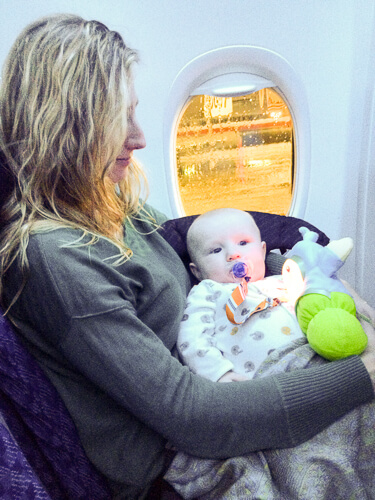
BREASTFEEDING ON AN AIRPLANE
When you have the luxury of taking your little one along for the trip, I highly recommend leaving the pump at home and exclusively breastfeeding. It’s much easier just to pop a baby under a wrap to feed than it is to lug around a big pump and milk. Even in places with “mothers’ rooms”, it can be a difficult task to set up and clean up. On top of that, you’d have to wrangle your child while you’re physically attached to a machine. There’s also the issue of milk storage and making sure it’s kept at the proper temperature every time you’re in transit.
If you’re exclusively breastfeeding, the process is pretty simple – no special luggage or timing needed. The main thing you will need is a wrap. I use this one from Bamboobies. It’s lightweight and breathable, which becomes imperative when traveling to hot locations.


There is some debate on whether the window or aisle seat is the best option. My personal preference is a window seat because it provides more privacy. Just by turning to face the wall, you can almost create your own little room. However, the downside is that you will have to bother your neighbor every time that you need to get up- which with a baby can be quite often. Standing up and bouncing baby or walking the aisles can calm a crying baby, and easy access to the bathroom is always a plus. There are pluses and minuses to each seat, but if breastfeeding and traveling alone, privacy wins out, and I always choose the window.
Most cultures are completely accepting of public breastfeeding, but I recommend looking for a discreet location like a park while out and about. At a public facility like a museum, ask if there is a mother’s room or private place available. They are usually very accommodating, but the wrap allows you to breastfeed just about anywhere.
I do recommend practising feeding your baby under a wrap before you go. If he isn’t used to being under a cover while eating it can sometimes cause a bit of a fight, especially if it’s warm where you are.
READ MORE: SURVIVING THE AIRPORT WITH A BABY
PUMPING WHILE TRAVELING
Now, if you’re traveling for work or just leaving the little one behind for a bit, you’ll need your pump. Luckily, airports and airlines make it pretty easy to pump on the road, but you’ll need to leave a little more time.
Pumps are considered a medical device, so they can be brought on the plane in addition to your carry-on allowance. (It’s never a bad idea to double-check allowances with your airline though.)
Even the shortest flights will usually keep you occupied for at least three hours, what with boarding, flight and deplaning time. That means you’ll probably want to plan to pump right before boarding. Make sure to work this extra time in to your airport arrival time. If no mother’s rooms are available at your airport, you can often find a deserted gate to pump in relative privacy. A nursing wrap or poncho is pretty essential in this situation though.
If you’re flying long haul, you’ll probably need to pump while in the air. To do this, you’ll want to have a pump battery pack with fresh (and probably spare) batteries. There may be places to plug in, but that’s likely to be a hassle, so better to be prepared. Remember that the flight attendants are your friends (they seriously ROCK with helping manage most baby situations mid flight). They may be able to help you locate an empty row, or let you hog the bathroom for a bit longer. Otherwise, you can use your wrap to pump in your seat.

TSA WITH BREASTMILK
Milk storage is going to be one of the main concerns when pumping while traveling. Remember to freeze the pump ice pack before you leave, because you’ll need all the cooling you can get.
Bring a small collapsible cooler, like this one, to get the pumped milk cool while you travel. If you’re staying in a hotel room without a refrigerator, don’t be afraid to explain the situation and ask. I’ve always been able to get one delivered to my room without any problems. Sometimes you’ll hear advice to freeze the milk. I’ve never chosen to do this because I didn’t want it to thaw in transit and then have to be used immediately. If you need additional ice at the airport, just pop in to one of the restaurants. Every one I’ve asked has been more than happy to oblige.
Grab a couple of newspapers along the way, and wrap up the expressed milk bags one or two at a time before putting them in the cooler. This is a little tip that I learned from a caterer friend of mine, and it works fabulously.
Allow PLENTY of time for security when traveling with milk. It can be carried on, even though it greatly exceeds the liquid allowance. Let the TSA agent know that you are carrying breast milk in your cooler and you will have to go through additional screening. Each bag of expressed milk will have to be unwrapped (if wrapped in newspaper), and the exterior wiped with a test strip. If you’ve been gone for more than a day or two, this can be a somewhat lengthy process. You can find the official TSA information on traveling with children, including breastmilk, HERE.
If traveling internationally, make sure to check the regulations of the countries you will fly to and from(don’t forget that you sometimes must go through security even on a layover). Some countries do not allow excess breastmilk to be carried on unless traveling with an infant.
Other options
You can check a cooler full of breast milk, but be sure to have plenty of ice packed with it. That’s especially important if the milk is frozen, as it will likely thaw in transit. Another option is to have the milk shipped home, but this will come at a hefty price compared to bringing it on the plane.
DONT PANIC
There are few extra steps to take when traveling as a breastfeeding mother, but with a bit of preparation, it’s easy-peasy. Check out some of my other tips for flying and traveling with babies. From breastfeeding on a beach in Curacao to calming a sick baby losing it at 30,000 feet, I’ve been through it all and come out on the other side with amazing memories!
READ NEXT: MINIMALIST BABY PACKING GUIDE
PIN IT!
About the Author: Kristin Young